A lot has happened on Shifting Thresholds in the aftermath of Trugs, Stored Potential, and Elevate. We have been working tirelessly on the mapping research, conducting interviews, community engagement, and considering the project’s next evolution. Kayla and I have clocked over 1,500 miles driving around the diverse landscape of Omaha’s southern suburban/rural edge, and have to date interviewed 45 local residents, including farmers, the development community, county officials, and suburban residents. On June 26th, we held a charrette with an advisory team comprised of Sarah Thomas, Sloan Dawson, Emily Andersen, and Drew Seyl. We received critical input about the final stages of research and the project’s future phases. (more…)
It has been almost three weeks since Elevate turned the 36th Street bridge into a vibrant place, full of a unique energy and spirit for a brief moment. Whether a chef, designer, event sponsor, banner sponsor, banner artist, volunteer, events team member, pedicab driver, neighbor who lent a wheelbarrow or an entire parking lot, ticket purchaser, or a passerby, the experience of Elevate seems to have left those involved with a sense of curiosity, and we hope – utter delight about our community. For me, it was amazement at the creative talent here, the enjoyment of teamwork, and the possibilities that lie in unexpected places. Food, drink, multiple conversations, and maybe even new acquaintances later, we hope everyone left the bridge thinking ‘This is Why I Live in Omaha’.
Thank you, sincerely, to everyone involved. We hope it is a day you will remember for many weeks to come.
Scroll down for photos.
Thank you, again, to all the station design teams for your creativity, resourcefulness, dedication, and energy.
Emerging Terrain Events Team: Emily Bannick Lacey, Brigitte McQueen, Katrina Stoffel, Kayla Meyer, Jeff Green/Davis Erection, Jay Rybin
Elevate Sponsors: Big Wheel Brigade and Secret Penguin
1 Tim Shew / Nancy Novak + Drew Johnson
B & G Tasty Foods, Union Pacific, Drake-Williams Steel, Sunderland Brothers Company, Fisher Building Services, Joe Tess Place, Weitz, Davis Erection
2 Matthew Taylor / Bob Trempe + Brian Hamilton
The National Arbor Day Foundation, Lied Lodge and Conference Center, RDG Dahlquist Art Studio, Plum Creek Farm, Shadowbrook Farm, Perfect “ten” Bison Ranch, Dave Hutchinson and family, TD Niche Farm
3 Mark’s Bistro / Ryan Fisher + Andrew Conzett + Colin Conces
Ryan Fisher, Andrew Conzett, Colin Conces, Davis Erection
4 Nebraska Brewing Co. / Grant Landreth + Chris Jansen
EcoStores Nebraska, Jim and Virginia Conway, Julie Dierberger and Jessie Dewitt, Craig Jansen, Larry and Sharon Landreth, Becky Swanson, Jay Swanson
5 Stokes Grill & Bar / b2lab
B2LAB, INC., Ronco Construction, LLC, White Lotus Group, Look Architectural Coatings, Titan Machinery, Buss Family Farm, Hotel Deco XV
6 Boiler Room / HDR
Paul Kulik, Boiler Room, HDR Architecture, Kiewit Building Group, Omaha, Miller Electric, Omaha, Iron-Knee Co., Paul Konchagulian, State Steel, Puritan, Eagle Enclosures, Honey Creek Farms, Shadowbrook Farm, Tenuta Angoris/Villa Locatelli, Peripherique Wine Merchants, Italian Vine
7 bread&cup / Rudolphi + Leslie
8 Institute of Culinary Arts / PEN + Miller + Davis / Growing Cities
PEN Architect, BVH Architects, George Paul Vinegar, Heritage Nursery, Spotlight Presentations
11 Chris Myers / Urban Alchemy + architectureisfun + Dahlin Studio
James Dahlin, Sr., Tom Rossi, Terry and Catherine Ferguson, Chef Robert Anaya, Lauritzen Gardens, Botanical Interests, Renze Display, Todd Valley Farm, Bluff Valley Farm, Millard Lumber, Patton Equipment, Leo A. Daly
15 M’s Pub + Vivace / AToM Design Studio + UNL Architecture
Birdsong Farm, Graddy’s Tomato Farm, H’Olaffson Specialty Foods, Natures Best Gardens, Omaha Farmers Market, Squeaky Green Organics, Courtyard Inc., Lowe’s, Millard Lumber, Regal Plastic, Sherwin-Williams, The Waldinger Corporation, Randy and Kim Dickhut, The Home Depot
16 Grey Plume / TACKarchitects
Bob Grinell, R.L. Grinnell Corporation, Danna Grinell, Ridonkulous Acres, The Mastercraft Building, Palleton, Inc.
17 Sara Adkisson Joyner / Sara Jacobson + Allyson Gibbs + Alex Bodell
Last week we participated in the Rural Futures Conference in Lincoln, Nebraska, a collaborative initiative led by the University of Nebraska to discuss the future of rural America, with a tendency towards Nebraska and the Great Plains. The conference brought together 500 people from across the nation and world. Anne participated in a panel discussion on the opening night of the conference which included other young Nebraska leaders. We also presented some research for Shifting Thresholds in both the print and digital presentation exhibits. Turn on your sound and check out the presentation above.
Creating this presentation was very helpful to further develop Shifting Thresholds. The way that Sarpy County has been urbanized is largely reactive; reactive to policy changes, familial circumstances, and agricultural technology innovations; resulting in farmers selling land because they have no other choice and resulting developments take the form of 160-acres of former agricultural land. We have developed a research methodology that will help us understand these generational shifts in ownership by creating separate timelines related to changes in legislative policy, tax codes, agricultural technologies, and agribusiness. We will be able to draw relationships between these timelines and changes in ownership at specific moments in time. By relating these timelines to the aerial photography, ownership maps, and information from driving interviews, we can begin to conceptualize how future development of the rural-suburban edge of Sarpy County can opportunistically anticipate some of these reoccurring trends.
Albert Pope says the following about the suburban-rural edge, “There can be no urban interior and natural exterior for the simple reason that there simply is no exterior to our ecology. There is only one environment and everything, every creation and every destruction, must be entered on the balance sheet. An urban system closed off from, and all but blind to the natural systems that support it creates an exterior capable of being abused with impunity.” Check out the rest of this paper titled “Blue Archipelago” here.
We are really busy moving forward with these timelines in addition to continuing work on ownership maps, driving interviews, and aerial graphics. In addition, will be engaging the public of Sarpy County in a site-specific workshop to discuss this research and where we hope to move the project in the next phase. This will take place in July. At this point we don’t know exactly how this workshop will take form, but we are developing ideas and have a design and development charrette planned for June.
We are still very actively seeking driving interviewees. If you or someone you know lives, farms, or is involved in the community of Sarpy County and would be interested in participating in an interview, please email me at [email protected], so we can add them to the list of potential interviews.
If you didn’t see the last update about Shifting Thresholds Update please check it out here.
Elevate is only a few weeks away. It seems like just yesterday our board of directors came up with the idea of holding our next undertaking on a bridge over I-80, in full view of a new set of grain elevator banners about Transportation. Shortly thereafter, an inspired Events Committee came up with the name Elevate to describe unlikely collaborations; some of the city’s most creative food and spatial designers challenged to expand the possibilities discovered through the first event. The Harvest Dinner in 2010 combined the topics food and land use at one 800-foot long table on an old rail corridor next to the elevator. The result was more like an afternoon of performance art, blurring actor and attendee whereby those sitting at the table were as involved in the process as those growing, preparing, and serving the 6-course meal. Those coming to partake are just as integral to the process through their investment in something unprecedented and unpredictable.
Elevate has become a unique creature, built upon the Harvest Dinner. Through collaborations (architects/designers, chef, and local food producers) we have only seen happen inside the walls of restaurants, teams have been working together to create structures that speak to how food, land use, and transportation are inseparable in our city and culture. By doing so on a bridge with a view, Elevate is meant to be a celebratory, creative, impeccably delicious, thought provoking experience.
The most exciting part about Elevate has been experiencing these teams working together. Architects and engineers working with farmers and chefs, exploring new ways of involving the community in their ideas, new methods of fabrication, and new ways of presenting the possibilities of how food is produced and presented. We’ve watched teams move into spaces around the city we never knew existed to build their stations, deconstruct buildings from rural places to reconstruct anew, and reconfigure salvaged transportation infrastructures to express how intertwined movement and food really are.
Elevate is a vehicle for these collaborations and for providing the resources through 100% of ticket sales to make these structures and the food they will serve. After June 3, as determined by each team, their structures will go on to inhabit other parts of the city for a day or weekend or longer. We hope the structures might find strategic permanent homes, spur new kinds of innovative businesses, site specific events, and even become an anticipated part of each summer and fall here in Omaha.
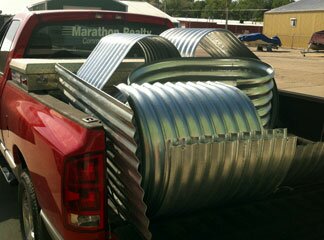
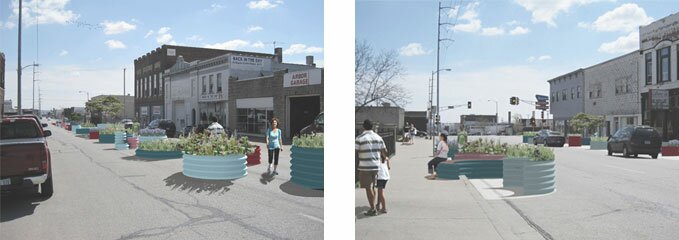
With the official Trug: Leavenworth kickoff scheduled for May 24th (mark it on your calendars!), I am in the middle of making sure the Trug platforms and seating/planter modules are constructed in time for the launch. Yesterday afternoon I dropped off the final set of corrugated metal to be painted at Helm Auto Body. Since I’m currently waking-eating-sleeping Trug design and fabrication, I’m going to use this opportunity to tell you about the design process of the corrugated metal seating/planter modules.
Last summer, soon after the Greater Omaha Chamber suggested that we collaborate on a project to enliven a section of Leavenworth Street (more on that another time), Anne and I looked at ubiquitous industrial materials that would allow us to design and deploy something in a short amount of time.
We became interested in corrugated metal pipe (aka culvert pipe) as a versatile, common, and durable material that comes in a wide range of sizes. Early ideas used pipe sections as planters that did not require much material manipulation, relying on sheer number for impact. We drew inspiration from the Walklet, Parking Day, Parallel Park, and other temporary urban installations. The design evolved as we proposed cutting and reconfiguring pieces of the pipe to make not only planters, but seating as well.
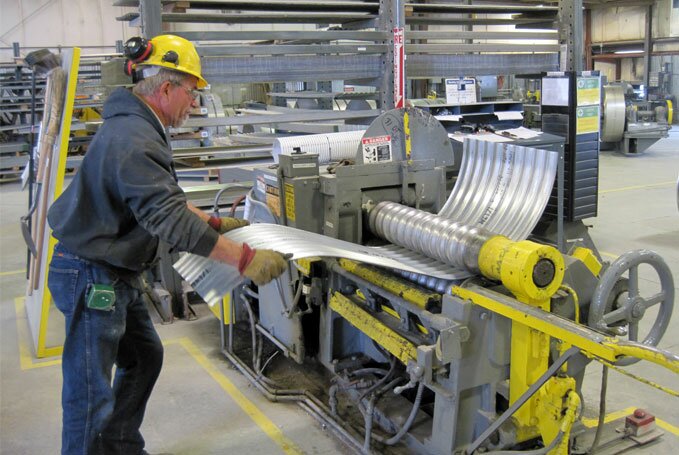
The real breakthrough came when we finally visited Contech in Wahoo and learned that annular pipe (there is also a helical variety) is still made in the way it’s been done for a century: by individually hand-feeding sheets of corrugated metal into a roller.
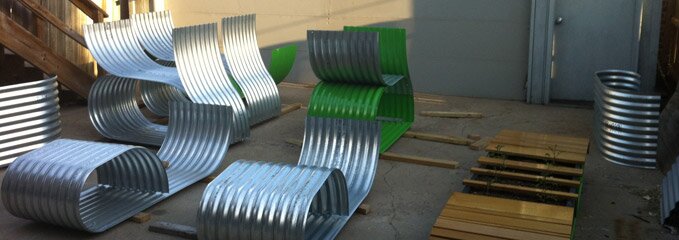
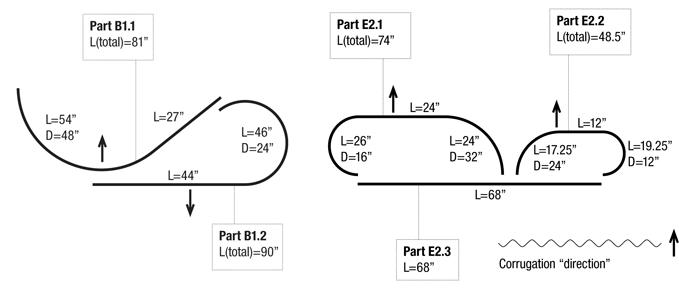
We saw the possibility for partially rolled sheets, and the guys at Contech were happy to try it out. After many more design iterations (with plenty of ugly ones along the way), we arrived at the looping, peeling, ribbonlike forms of the Trug seater/planter modules—shapes that come from the material and fabrication method.
Because the shapes are so closely linked with the tooling, the fabrication drawings can be very simple. And since each piece is rolled by hand on demand, it allows for the design to be approached “parametrically”—i.e., as a system based on rules and variable parameters. In this case, we have a system made up of straight and curved sections of corrugated metal, but the lengths and diameters can change to make various types of seating and planter modules.